Hey everyone, it is me again, Dan, welcome to our recipe page. Today, I will show you a way to prepare a special dish, basic congee (chinese porridge). One of my favorites food recipes. This time, I will make it a little bit tasty. This is gonna smell and look delicious.
Basic Congee (Chinese Porridge) is one of the most favored of recent trending foods on earth. It’s easy, it’s quick, it tastes delicious. It’s appreciated by millions every day. They are nice and they look wonderful. Basic Congee (Chinese Porridge) is something which I have loved my whole life.
This basic congee recipe is a great starter for making the classic Chinese rice porridge. It gets umami flavor from dried shrimp, dried scallops, and shiitake mushrooms. The word congee derives from Tamil, and different Asian cultures have their own version of this delectable, often savory, rice porridge.
To begin with this particular recipe, we must prepare a few components. You can have basic congee (chinese porridge) using 19 ingredients and 7 steps. Here is how you can achieve it.
The ingredients needed to make Basic Congee (Chinese Porridge):
- Take Congee
- Take Step 1 Simple Chicken Broth
- Make ready 1 Chicken
- Prepare 1 tbsp Chicken Granules/powder
- Get 1 big yellow onion - chopped big
- Prepare 6 garlic - crushed
- Get 8 big slices of garlic
- Get Coriander roots - see pic
- Prepare Step 2 Rice Congee
- Prepare 3 C Rice - Soaked
- Get 6 C water
- Make ready Congee Accompaniments
- Make ready Sesame oil (drizzle over served congee)
- Make ready Ground white pepper (opt)
- Get Finely chopped coriander
- Get Shreaded chicken
- Get Peanuts
- Prepare Fried mixed onions
- Make ready Fried anchovies
The word 'congee' itself is a derivation of the Tamil word kañci or kanji. When eaten as plain rice congee. This simple congee rice porridge recipe is made from chicken stock, rice and fresh ginger. Basic Chinese Congee. © Todd Porter & Diane Cu.
Steps to make Basic Congee (Chinese Porridge):
- Note: For plain congee, skip step 1 chicken broth. Use only water. Below: coriander roots
- Step 1 - Stuff chicken cavity with 3 crushed garlic and 4 big slices of ginger. Put everything in a pot & Cover chicken with just enough water (not too much). Cook over high heat until it reaches boiling point. Leave it to boil for at least 5 - 10 mins.
- Next, turn the heat to low and allow to simmer for 30mins. After 30mins remove chicken from the pot and Keep the broth.
- Step 2 - Clean & soak rice for 10mins or more. Place rice in a big pot. Add water and cook over high heat until it boils. Leave it boiling for good 10mins until rice is cooked through and mushy but not starchy. Stir in between. Add some water if necessary.
- Next, pour chicken broth into congee pot. This time, over LOW HEAT, Simmer congee for at least 30 minutes or more, until it reaches a thick starchy consistency, NOT WATERY. Taste and adjust accordingly. It should taste subtle as congee is usually served with other side dishes. See Note.
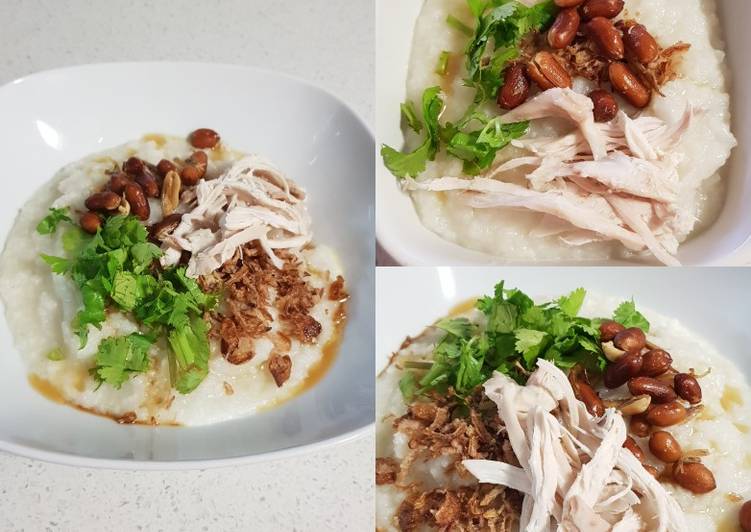
- Serve congee in a bowl and drizzle some SESAME OIL (optional) and Top with shredded chicken, peanuts, fried crispy anchovies, chopped coriander, fried shallots and garlic, red fermented bean curd or tofu, chinese preserved olive leaves or vegetable, chinese pickled lettuce and so on. Accompaniments for congee are usually based on individual preferences.
- Note : Seasoning congee is depending on how congee is served. If congee is served with side dishes or few accompaniments, seasoning is not necessary. If congee is served on its own with shredded chicken, chopped coriander, fried anchovies and peanuts, then, season your congee (to taste) with enough chicken seasoning powder or chicken bouillon.
Some people like a thin porridge. So, I thought I might share this basic part of making Asian rice porridge using white rice. Congee refers explicitly to Cantonese porridge originated from Guangdong or Hong Kong, China. Congee, one type of rice porridge is one of the most popular staple food in lots of Asian countries, sometimes also served as breakfast. Congee can directly be served as a meal with other stir-fry dishes in summer days.
So that is going to wrap this up for this special food basic congee (chinese porridge) recipe. Thanks so much for reading. I am confident that you can make this at home. There’s gonna be interesting food in home recipes coming up. Don’t forget to save this page in your browser, and share it to your loved ones, colleague and friends. Thanks again for reading. Go on get cooking!