Hey everyone, it is me again, Dan, welcome to our recipe site. Today, we’re going to make a special dish, all-purpose traditional japanese sauce (dashi soy sauce). It is one of my favorites food recipes. For mine, I am going to make it a little bit tasty. This is gonna smell and look delicious.
Japanese soy sauce, or shoyu, is an essential part of Japanese cuisine. Without this sauce, many of your favorite Japanese dishes would not exist. But did you know soy sauce comes in different flavors, colors, and textures?
All-Purpose Traditional Japanese Sauce (Dashi Soy Sauce) is one of the most well liked of recent trending meals on earth. It’s simple, it’s quick, it tastes delicious. It is enjoyed by millions daily. They are nice and they look fantastic. All-Purpose Traditional Japanese Sauce (Dashi Soy Sauce) is something that I’ve loved my entire life.
To get started with this particular recipe, we must first prepare a few components. You can have all-purpose traditional japanese sauce (dashi soy sauce) using 6 ingredients and 4 steps. Here is how you cook it.
The ingredients needed to make All-Purpose Traditional Japanese Sauce (Dashi Soy Sauce):
- Make ready 300 ml Soy sauce
- Prepare 300 ml Sake
- Prepare 200 ml Mirin
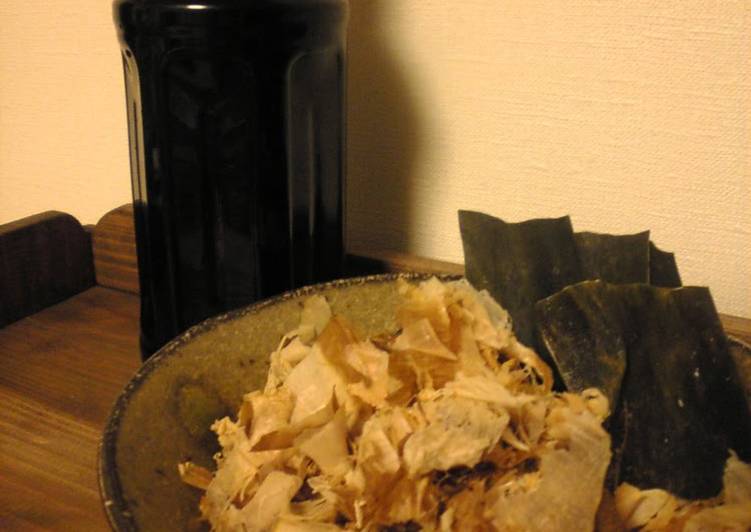
- Take 20 grams Bonito flakes (about 2 big handfuls)
- Get 10 grams Kombu for dashi stock (about 4 to 5 10 cm x 3 cm pieces)
- Take 1 Shredded nori seaweed, white sesame seeds (for the furikake)
The type of soy sauce used in largely influenced by what part of the country you live in. - We have a collection of soy sauces from all over Japan. - We have a wide variety including red miso, white miso, rice miso, soy miso, and barley miso. Miso is a fermented food, made by adding salt and a starter to soybeans and grains of rice or barley and fermenting. All the dried ingredients that are used to make Japanese soup stock are rich in naturally occurring glutamates and provide intense flavor to the stock. Use when you want a nice savory stock to go with other strong distinct flavors or seasoning like soy sauce, but don't use it.
Steps to make All-Purpose Traditional Japanese Sauce (Dashi Soy Sauce):
- Put all the ingredients except the nori seaweed and sesame seeds into a pan and turn on the heat. Once it comes to a boil, turn the heat down to low and simmer. Continue simmering for 15 to 20 minutes until the liquid has reduced by 2/3.
- Take the pan off the heat, and let cool. When it's cooled, strain it through a fine meshed sieve or paper towels. You'll end up with about 500 ml of dashi.
- How to reuse leftover bonito flakes: Spread it out on parchment paper-lined baking sheet. Bake in an oven preheated to 195-210°F/90-100°C. Around the time you've forgotten about it, it will be nicely dried (about 1 hour). P.S. Be careful not heat the oven too high, this will dry out the flakes. You can also dry-roast in a frying pan.
- Add finely shredded nori seaweed and white sesame seeds, for gorgeous, delicious bonito flake furikake! Store in an airtight container in the refrigerator. I recommend eating this with rice! It's so good!
All types of dashi impart a rich, savory taste, thanks to the naturally occurring glutamic acid in the dried ingredients the dashi stock requires. Japanese dashi is best used on the day it's made. If you have some leftover dashi, however, keep it in a covered container refrigerated for up to a week or freeze to. Most but not all Japanese soy sauces include wheat as a primary ingredient, which tends to give them a slightly sweeter taste than. All soy sauce is not made equal!
So that’s going to wrap it up with this exceptional food all-purpose traditional japanese sauce (dashi soy sauce) recipe. Thank you very much for reading. I’m confident you will make this at home. There is gonna be interesting food at home recipes coming up. Remember to bookmark this page on your browser, and share it to your loved ones, colleague and friends. Thank you for reading. Go on get cooking!